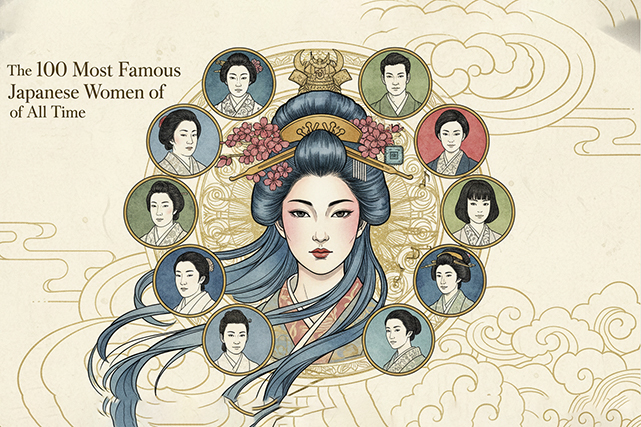
This list highlights 100 of the most famous Japanese women of all time, from Heian-era poets and empresses to modern artists, athletes, singers, and authors. Each entry includes a short note on why she is remembered.
It also doubles as a baby name idea list. Japanese girls’ names are often short, soft-sounding, and full of meaning, which makes them a lovely choice for American parents who want to honor Japanese heritage or simply love the sound.
The 100 Most Famous Japanese Women of All Time
| No. | Name | Occupation / Why Famous |
|---|---|---|
| 1 | Murasaki Shikibu | Author of The Tale of Genji |
| 2 | Himiko | Shaman-queen of Yamatai |
| 3 | Empress Jingu | Legendary empress regent and warrior |
| 4 | Sei Shonagon | Author of The Pillow Book |
| 5 | Tomoe Gozen | Famous female samurai (onna-musha) |
| 6 | Ono no Komachi | Renowned waka poet and beauty |
| 7 | Empress Suiko | First officially recognized female monarch |
| 8 | Hojo Masako | Political leader known as the Nun Shogun |
| 9 | Izumi Shikibu | Heian period poet and lady-in-waiting |
| 10 | Yodogono | Influential figure during the Sengoku period |
| 11 | Tensho-in (Atsuhime) | Wife of Tokugawa Iesada; influential in the Meiji Restoration |
| 12 | Ichiyo Higuchi | Prominent Meiji era novelist featured on the 5,000 yen note |
| 13 | Raicho Hiratsuka | Pioneering feminist and writer |
| 14 | Yosano Akiko | Poet and social reformer |
| 15 | Umeko Tsuda | Educator and founder of Tsuda University |
| 16 | Sadako Sasaki | Symbol of peace known for the thousand origami cranes |
| 17 | Yayoi Kusama | World-renowned contemporary artist |
| 18 | Yoko Ono | Multimedia artist and peace activist |
| 19 | Naomi Osaka | Professional tennis champion |
| 20 | Chiaki Mukai | First Japanese female astronaut |
| 21 | Hibari Misora | Legendary singer and cultural icon |
| 22 | Momoko Sakura | Creator of Chibi Maruko-chan |
| 23 | Rumiko Takahashi | Influential manga artist of Inuyasha and Ranma 1/2 |
| 24 | Naoko Takahashi | Olympic gold medalist in marathon |
| 25 | Mao Asada | World champion figure skater |
| 26 | Hikaru Utada | Best-selling J-pop singer-songwriter |
| 27 | Namie Amuro | Known as the Queen of Japanese Pop |
| 28 | Machiko Hasegawa | Creator of the Sazae-san manga |
| 29 | Fusae Ichikawa | Leader of the women’s suffrage movement |
| 30 | Sugako Hashida | Prolific screenwriter of Oshin |
| 31 | Shizuka Arakawa | Olympic gold medalist figure skater |
| 32 | Homare Sawa | Captain of the World Cup-winning football team |
| 33 | Kaori Icho | Four-time Olympic gold medalist wrestler |
| 34 | Saori Yoshida | Highly decorated Olympic wrestler |
| 35 | Tsuruhime | Legendary female warrior of Omishima |
| 36 | Empress Koken | Twice-reigning empress of the Nara period |
| 37 | Empress Jitō | Empress who oversaw the Fujiwara-kyo capital |
| 38 | Sugawara no Takasue no Musume | Author of the Sarashina Nikki |
| 39 | Izumo no Okuni | Founder of Kabuki theatre |
| 40 | Nakano Takeko | Leader of the Joshitai (Women’s Army) |
| 41 | Chiyo Uno | Notable author and fashion designer |
| 42 | Sawako Ariyoshi | Prolific novelist and social critic |
| 43 | Fumiko Enchi | Important 20th-century female novelist |
| 44 | Banana Yoshimoto | Internationally acclaimed novelist |
| 45 | Seiko Hashimoto | Politician and Olympic medalist |
| 46 | Yuriko Koike | First female Governor of Tokyo |
| 47 | Sadako Ogata | Former UN High Commissioner for Refugees |
| 48 | Junko Tabei | First woman to climb Mount Everest |
| 49 | Hanae Mori | Renowned fashion designer |
| 50 | Rei Kawakubo | Founder of Comme des Garçons |
| 51 | Chitose Abe | Founder of the fashion brand Sacai |
| 52 | Satomi Ishihara | Popular actress and model |
| 53 | Masami Nagasawa | Award-winning film and television actress |
| 54 | Keiko Kitagawa | Famous actress and former model |
| 55 | Haruka Ayase | Leading actress and singer |
| 56 | Kyary Pamyu Pamyu | J-pop singer and Harajuku icon |
| 57 | Seiko Matsuda | Iconic 1980s pop idol |
| 58 | Akina Nakamori | Famous pop singer and actress |
| 59 | Mariya Takeuchi | Singer-songwriter known for Plastic Love |
| 60 | Miki Nakatani | Award-winning actress |
| 61 | Rinko Kikuchi | Academy Award-nominated actress |
| 62 | Shinobu Terajima | Silver Bear-winning actress |
| 63 | Sayuri Ishikawa | Famous enka singer |
| 64 | Misia | R&B singer with a powerful vocal range |
| 65 | Ayumi Hamasaki | Best-selling solo artist in Japanese history |
| 66 | Koda Kumi | Popular pop and urban singer |
| 67 | Kana Kurashina | Popular actress |
| 68 | Gōkō-no-Tsubone | Important court lady in the Muromachi period |
| 69 | Lady Kasuga | Nurse to Shogun Tokugawa Iemitsu |
| 70 | Oei (Katsushika Oi) | Ukiyo-e artist and daughter of Hokusai |
| 71 | Tasha Shisui | Renowned haiku poet |
| 72 | Chiyo-ni | Famous Edo period haiku poet |
| 73 | Etsu Inagaki Sugimoto | Author of A Daughter of the Samurai |
| 74 | Shizue Kato | Pioneer of birth control and women’s rights |
| 75 | Fusako Shigenobu | Founder of the Japanese Red Army |
| 76 | Ryoko Hirosue | Famous actress and singer |
| 77 | Miwa Akihiro | Singer, actor, and drag queen |
| 78 | Ai Fukuhara | Popular professional table tennis player |
| 79 | Kasumi Ishikawa | Olympic medalist in table tennis |
| 80 | Mima Ito | Table tennis star and Olympic medalist |
| 81 | Sara Takanashi | Highly successful ski jumper |
| 82 | Kane Tanaka | Once the world’s oldest living person |
| 83 | Marie Kondo | Organizing consultant and author |
| 84 | Hiromi Kawakami | Award-winning novelist |
| 85 | Mieko Kawakami | Author of Breasts and Eggs |
| 86 | Sayaka Murata | Author of Convenience Store Woman |
| 87 | Naoko Takeuchi | Creator of Sailor Moon |
| 88 | Hiromu Arakawa | Creator of Fullmetal Alchemist |
| 89 | Moto Hagio | Pioneer of shojo manga |
| 90 | Ryoko Ikeda | Creator of The Rose of Versailles |
| 91 | Atsuko Maeda | Former lead member of AKB48 |
| 92 | Sashihara Rino | Popular television personality and idol |
| 93 | Su-metal (Suzuka Nakamoto) | Lead singer of Babymetal |
| 94 | LiSA | Popular singer of anime theme songs |
| 95 | Aimer | Renowned pop singer with a unique voice |
| 96 | Hinako Shibuno | Professional golfer and major winner |
| 97 | Ai Miyazato | Former world number one golfer |
| 98 | Kimiko Date | Pioneering professional tennis player |
| 99 | Tamayo Marukawa | Politician and former TV announcer |
| 100 | Empress Masako | Current Empress of Japan and former diplomat |
Read more: The 100 Most Famous Japanese Men of All Time
Baby Name Ideas Inspired by Famous Japanese Women
These given names come from women on the list above. In Japanese, the meaning of a name depends on the kanji (characters) chosen, and the same name can be written many different ways. The meanings below are for the specific characters each namesake uses.
| No. | Name | Meaning | Origin | Famous Namesake |
|---|---|---|---|---|
| 1 | Yoko | 洋子: ocean + child | Japanese | Yoko Ono |
| 2 | Yayoi | 彌生: an old name for the third month of the lunar calendar, linked to spring | Japanese | Yayoi Kusama |
| 3 | Mao | 真央: true + center | Japanese | Mao Asada |
| 4 | Umeko | 梅子: plum + child | Japanese | Umeko Tsuda |
| 5 | Akiko | 晶子: sparkling, crystal + child | Japanese | Yosano Akiko |
| 6 | Yuriko | 百合子: lily + child | Japanese | Yuriko Koike |
| 7 | Junko | 淳子: pure, genuine + child | Japanese | Junko Tabei |
| 8 | Keiko | 景子: scenery, view + child | Japanese | Keiko Kitagawa |
| 9 | Rinko | 凛子: dignified, crisp + child | Japanese | Rinko Kikuchi |
| 10 | Shizuka | 静香: quiet + fragrance | Japanese | Shizuka Arakawa |
| 11 | Homare | 穂希: ear of grain + hope | Japanese | Homare Sawa |
| 12 | Chiaki | 千秋: thousand + autumn | Japanese | Chiaki Mukai |
| 13 | Naoko | 尚子: esteem + child | Japanese | Naoko Takahashi |
| 14 | Sara | 沙羅: the sal tree, sacred in Buddhism | Japanese | Sara Takanashi |
| 15 | Mima | 美誠: beauty + sincerity | Japanese | Mima Ito |
| 16 | Ai | 愛: love (Ai Fukuhara); 藍: indigo (Ai Miyazato) | Japanese | Ai Fukuhara, Ai Miyazato |
| 17 | Kasumi | 佳純: good, beautiful + pure | Japanese | Kasumi Ishikawa |
| 18 | Masako | 雅子: elegant, refined + child | Japanese | Empress Masako |
| 19 | Tomoe | 巴: a swirling comma-shaped design | Japanese | Tomoe Gozen |
| 20 | Hanae | 英恵: excellent + blessing | Japanese | Hanae Mori |
| 21 | Rei | 玲: the tinkling sound of jewels | Japanese | Rei Kawakubo |
| 22 | Chiyo | 千代: a thousand generations | Japanese | Chiyo Uno |
Japanese Naming Traditions
In Japan, the family name comes first and the given name follows. That is why some women on this list appear as Yosano Akiko and others as Yuriko Koike: English-language sources do not always use the same order.
Parents pick the kanji for a name carefully, since the characters set the meaning. The same spoken name can be written many ways. The two Ais on this list are a good example: one uses the character for love, the other the character for indigo. Names must use characters from officially approved lists, and some parents choose hiragana or katakana instead of kanji for a softer look.
For much of the 20th century, many girls’ names ended in -ko (子), meaning “child,” as in Yoko, Akiko, and Masako. The ending is less common for newborns today, and modern names often draw on nature, seasons, and qualities like kindness or beauty.
Under Japanese law, a married couple shares one family name, and in most cases the wife takes her husband’s surname. Members of the imperial family, including Empress Masako, have no family name at all.
How to Use These Names for Your Baby
- Pick your characters first. Decide on the kanji and its meaning before you settle on the name, especially if you have Japanese relatives who will read it.
- Keep spelling U.S.-friendly. Names like Yoko and Mao are usually written without long-vowel marks in English, which keeps forms and school records simple.
- Share the pronunciation. Japanese uses fairly even stress, so Akiko sounds more like ah-kee-koh than ah-KEE-koh. Let teachers and family know how you say it.
- Pair it with a middle name. A short name like Rei, Ai, or Mao pairs nicely with a longer English middle name. Browse our middle names for girls and boys for combinations.
- Look for meaning and length. Many of these names have lovely meanings, from lily to love. See more in our baby names with beautiful meanings and short baby names.
Finding the Right Name
From classical poets to Olympic champions, the women on this list carry names full of meaning and history. If one stands out to you, explore the characters behind it and choose the spelling that holds the meaning you want for your daughter. For more ideas, see the most famous Japanese men of all time.

Hello! I’m Emma Carter, born in 1990, and a passionate child development specialist. Alongside my work, I have a deep love for helping parents discover beautiful and meaningful baby names. I believe a name is more than just a label — it’s the beginning of a child’s story. I draw inspiration from languages, cultures, traditions, and even the hidden meanings behind names to help find the perfect fit for every little one’s bright future.
1 comment
Become our partner and turn referrals into revenue—join now!